
How Google Ads Auction Insights Can Reveal Competitive Opportunities
What Google Ads Auction Insights Can Teach You About Your Competitors
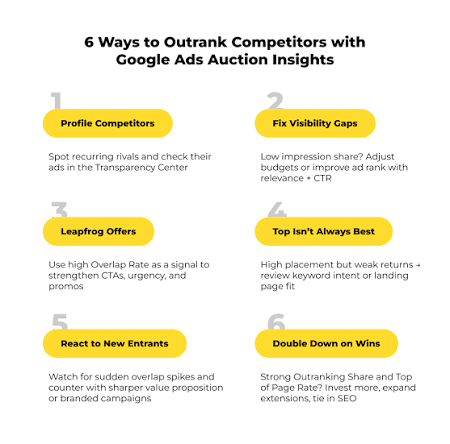
Businesses investing in Google Ads often wonder how frequently their advertisements appear alongside competing companies.
Are competitors showing advertisements more often? Are they appearing above your advertisements? Is your company missing opportunities because of limited budget or advertising performance?
Google Ads provides a reporting feature called Auction Insights that can help answer some of these questions.
Understanding this information can improve advertising decisions without relying on guesswork.
What Is Google Ads Auction Insights?
Auction Insights is a reporting feature that allows advertisers to compare selected advertising performance metrics with other advertisers participating in overlapping auctions.
The information available depends on campaign type and reporting eligibility.
For eligible Search campaigns, metrics can include impression share, overlap rate, position-above rate, top-of-page rate, absolute top-of-page rate, and outranking share.
These measurements provide useful competitive context.
However, Auction Insights does not reveal competitors' complete advertising budgets, keyword lists, profitability, or bidding strategies.
It offers comparative performance indicators rather than unrestricted access to competing accounts.
Understanding Impression Share
Impression share measures the percentage of impressions an advertisement received compared with the estimated number of impressions it was eligible to receive.
Suppose a campaign receives 4,000 impressions from an estimated 10,000 eligible opportunities.
Its impression share would be approximately 40%.
This suggests the campaign did not appear in every eligible opportunity.
Budget limitations, Ad Rank, and other auction conditions can influence impression share.
Before increasing spending, businesses should investigate why eligible impressions are being missed.
Sometimes additional budget makes sense.
Other times improving advertising relevance, landing pages, or campaign structure deserves attention first.
What Does Overlap Rate Mean?
Overlap rate indicates how frequently another advertiser received an impression in the same auction when your advertisement also received an impression.
This can help identify advertisers competing for similar searches.
For example, a roofing contractor might discover that a particular competing company frequently appears in overlapping auctions.
That information can encourage closer examination of campaign targeting and competitive positioning.
However, overlap does not prove that every advertiser offers identical services or targets exactly the same customers.
Position-Above Rate Provides Additional Context
Position-above rate measures how frequently another advertiser's advertisement appeared in a higher position than yours when both advertisements appeared in the same auction.
A high position-above rate may suggest a competitor frequently receives stronger placement.
That does not automatically mean the competitor is earning more customers.
Advertisement position is only one part of campaign performance.
A lower-position advertisement with stronger messaging and a relevant landing page may still generate valuable conversions.
Businesses should connect competitive metrics with actual campaign outcomes.
Why Being First Is Not Always the Best Strategy
Business owners naturally want their advertisements at the top.
Unfortunately, aggressively pursuing the highest placement can increase advertising costs without guaranteeing additional profitability.
Consider a company paying $12 per click in one position and $22 per click while pursuing more prominent placement.
If the additional cost does not produce enough qualified customers or revenue, the higher position may be difficult to justify.
The objective should be profitable advertising performance rather than winning every auction at any price.
Use Competitive Information to Improve Campaigns
Auction Insights becomes most valuable when combined with other campaign information.
Review conversion rates, cost per conversion, search terms, geographic performance, landing-page relevance, and budget utilization.
If impression share is declining while conversion performance remains strong, additional budget might be worth testing.
If clicks are increasing but conversions remain weak, the campaign may need adjustments before expansion.
At Shane Worley The Marketing 1 LLC, our Google Ads management services focus on measurable performance and ongoing campaign improvements.
Watch Competitive Trends Over Time
One report provides a snapshot.
Comparing reporting periods can reveal patterns.
Perhaps a competitor begins appearing more frequently during peak seasonal demand.
Maybe your impression share decreases after expanding into additional geographic markets.
Perhaps changes to your campaign structure coincide with improved competitive positioning.
These observations can help guide further investigation.
Avoid assuming that every change results from competitor behavior. Auction conditions, search demand, account settings, and campaign eligibility can also affect the numbers.
Geographic Competition Can Vary
Service-based businesses often compete across multiple communities.
An HVAC company may face intense advertising competition in Chicago while encountering different conditions in surrounding suburbs.
Analyzing geographic performance can help determine where advertising dollars produce the strongest opportunities.
The most competitive market is not necessarily the most profitable.
A smaller geographic area may deliver qualified customers at a more sustainable acquisition cost.
Connect Auction Insights With Your Broader Marketing Strategy
Paid advertising does not operate independently from SEO and other marketing channels.
A business with strong organic visibility may approach certain advertising opportunities differently from a company that depends almost entirely on paid traffic.
Our SEO services and digital marketing solutions help businesses evaluate how different channels contribute to customer acquisition.
Competition Is Information, Not a Strategy
Auction Insights can reveal where your advertising competes for visibility.
It cannot tell you whether copying a competitor's apparent behavior would be profitable.
Use the information to ask better questions, investigate campaign opportunities, and make decisions supported by your own conversion data.
If your Google Ads campaigns generate traffic but you lack clarity about competitive performance, contact Shane Worley The Marketing 1 LLC.
Understanding the competition is useful.
Understanding how to outperform your own previous results is even more valuable.