
Negative Keywords: Stop Wasting Money in Google Ads
Why Negative Keywords Can Protect Your Google Ads Budget
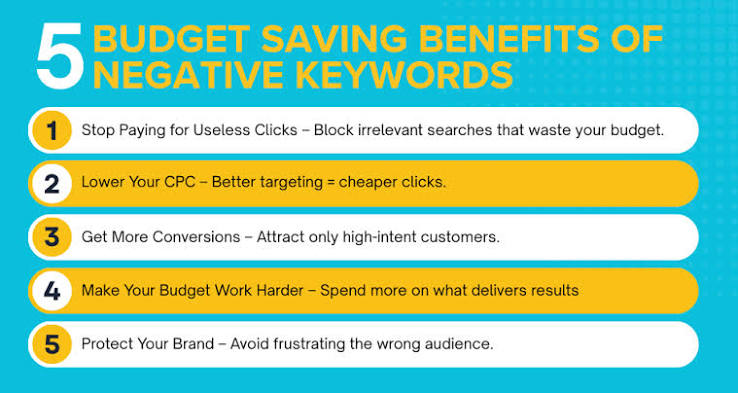
Pay-per-click advertising sounds beautifully simple: someone searches for your service, your advertisement appears, they click, and your business gets another opportunity to earn a customer.
Then reality arrives.
A roofing company advertising roof replacement could receive searches from people looking for roofing jobs. A cleaning company might appear for searches about cleaning products. A contractor could pay for clicks from people searching for DIY instructions.
Those clicks cost money.
This is where negative keywords become an important part of Google Ads management.
What Is a Negative Keyword?
A negative keyword helps prevent an advertisement from appearing for searches that do not fit the campaign's intended audience.
Suppose a local plumbing company is advertising professional drain cleaning.
Potentially irrelevant searches could include:
“drain cleaning jobs”
“DIY drain cleaner”
“free drain cleaning tutorial”
“how to make drain cleaner”
Those people may have no intention of hiring a plumber.
Adding appropriate negative keywords helps reduce exposure to searches that are unlikely to become customers.
Think of negative keywords as a bouncer standing outside your advertising budget. Their job is not to bring people through the door. Their job is to help keep the wrong crowd from consuming resources.
More Traffic Is Not Always Better
Businesses sometimes judge advertising success by click volume.
More clicks can feel encouraging. Unfortunately, Google Ads does not award businesses a trophy for collecting visitors.
The real objective is usually calls, appointments, quote requests, purchases, or another measurable conversion.
A campaign receiving 300 poorly matched clicks may perform worse than one receiving 100 clicks from people actively searching for the service.
This is why our pay-per-click advertising services focus on what happens after the click instead of treating traffic as the finish line.
Search Terms Can Reveal Wasted Spend
One of the most useful areas of a Google Ads account is the search terms data.
This information helps advertisers understand the searches associated with their advertising activity.
Reviewing those searches can reveal patterns.
You may discover people searching for employment, training, free resources, replacement parts, wholesale products, instructions, or services your company does not provide.
Each irrelevant pattern creates an opportunity to improve campaign targeting.
Negative keyword management should therefore be ongoing.
A campaign launched six months ago should not simply sit untouched because it produced leads during its first month.
Customer behavior changes. Search patterns change. Services change. Budgets change.
Campaign management should respond accordingly.
Negative Keywords Can Improve Budget Efficiency
Imagine spending $2,000 per month on Google Ads.
If a meaningful portion of that budget is consumed by visitors who were never realistic prospects, the problem is not necessarily that Google Ads “doesn't work.”
The targeting may need improvement.
Reducing irrelevant traffic can allow more of the existing budget to compete for searches that closely match the company's services.
That distinction matters for small businesses.
A national corporation might absorb inefficient spending while testing large campaigns. A local service business operating with a controlled monthly advertising budget usually has much less room for waste.
Every click should have a reasonable opportunity to contribute to the campaign objective.
Do Not Block Good Customers Accidentally
Negative keywords require judgment.
Being too aggressive can prevent advertisements from appearing for valuable searches.
For example, a business might see an unusual search phrase and immediately exclude a broad word contained within it. That exclusion could unintentionally block other searches that actually represent good prospects.
Negative keyword decisions should consider context, match behavior, campaign structure, and the services being advertised.
The objective is refinement, not simply creating the longest exclusion list possible.
Your Landing Page Still Matters
Better search targeting cannot rescue a poor destination.
Once someone clicks an advertisement, the landing page needs to continue the conversation started by the search and advertisement.
Google identifies landing-page experience as one factor associated with keyword Quality Score and considers characteristics including usefulness, relevance, and ease of navigation.
If someone searches for commercial HVAC repair, clicks an advertisement promoting commercial HVAC repair, and lands on a generic homepage that barely mentions the service, the journey becomes unnecessarily confusing.
A stronger approach connects the search, advertisement, landing page, and call to action.
Everything should make sense.
PPC Management Requires More Than Turning Ads On
Google Ads provides businesses with immediate access to potential customers, but paying for visibility does not automatically make that visibility profitable.
Campaign structure, geographic targeting, search terms, negative keywords, advertisements, landing pages, conversion tracking, and ongoing adjustments all play a role.
At Shane Worley The Marketing 1 LLC, we help businesses manage those moving pieces through transparent Google Ads and PPC management.
Our goal is simple: help your advertising budget work harder for your business.
If you are running Google Ads but are unsure where the money is going, it may be time to look beneath the headline numbers. Review the searches generating activity, identify unnecessary spending, and measure which clicks actually become leads.
Sometimes improving PPC performance is less about finding another place to spend money and more about stopping money from slipping through the cracks.
Contact Shane Worley The Marketing 1 LLC to discuss your current PPC campaigns and digital advertising goals.